How to Calculate AI Automation ROI for Your Service Business
Why Most ROI Calculations Are Wrong
Most AI vendors calculate ROI by comparing their cost to a full-time employee salary. This is misleading. A voice agent doesn't replace a CSR — it augments capacity, captures after-hours leads, and provides consistency. The real ROI comes from revenue you're currently losing, not headcount you're currently paying. To calculate correctly, you need to measure what's falling through the cracks today.
The Revenue Leakage Framework
Step 1: Count your missed calls (check your phone system's abandoned call report). Step 2: Multiply by your average ticket value. Step 3: Apply your close rate. That's your monthly revenue leakage. For a contractor doing $10M/year with 200 missed calls/month, a $500 average ticket, and a 40% close rate — that's $40K/month in leaked revenue. A voice agent that captures even half of that pays for itself in a matter of months.
Beyond Lead Capture: The Full ROI Picture
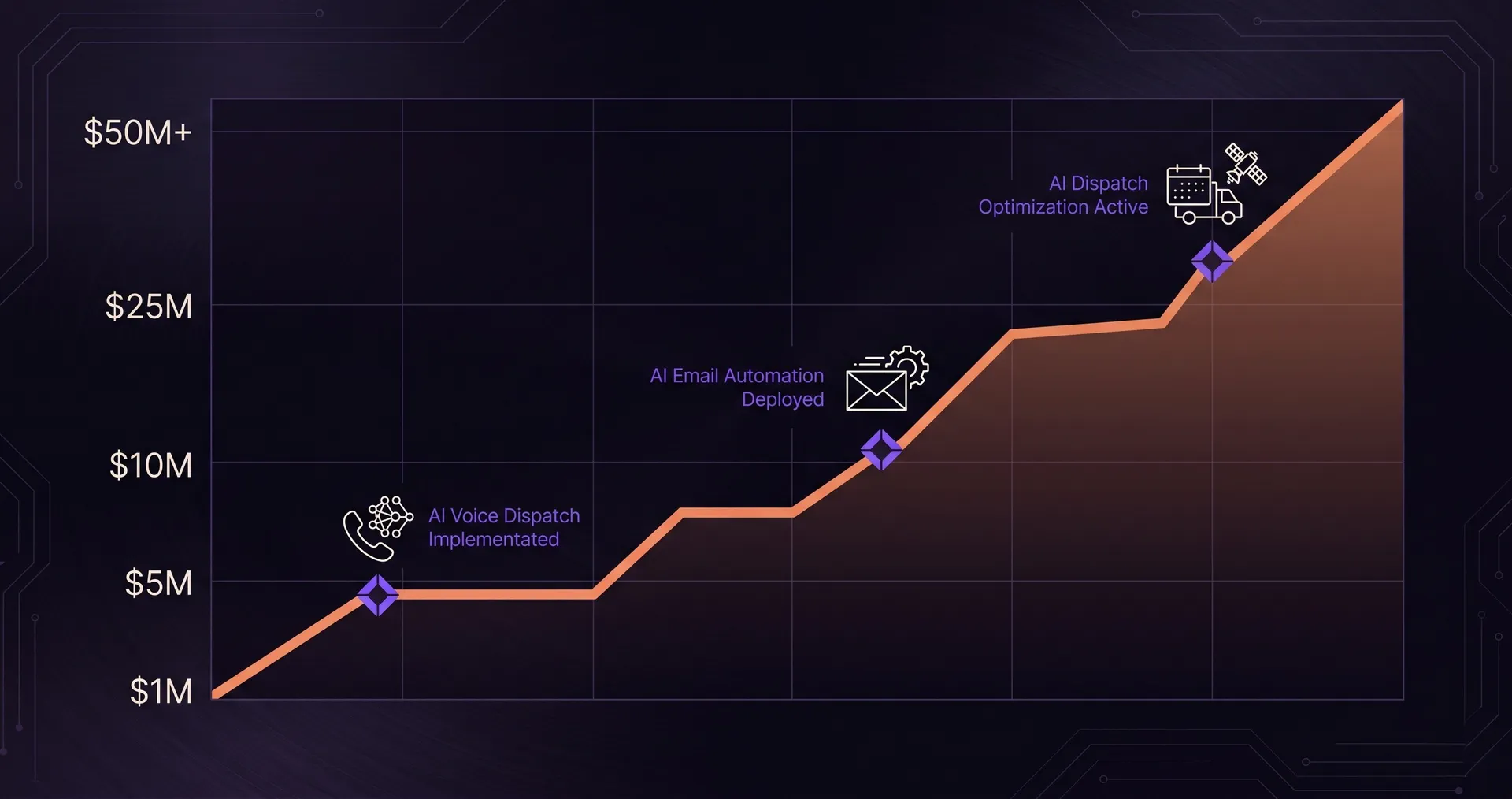
Lead capture is the easiest to measure, but automation ROI compounds across: speed-to-quote (faster quotes = higher close rates), review management (more reviews = more leads), rebooking automation (dormant customers reactivated), and dispatch optimization (fewer empty miles = better margins). A comprehensive deployment touching all four areas typically delivers 3-5x ROI in year one.
Real Numbers from Real Deployments
Concrete contractor (voice agent): +23% lead capture, $480K projected annual revenue lift. Multi-location cleaning company (review reactivation): 2.4x rebooking rate increase, $180K additional annual revenue. 3PL logistics operator (dispatcher copilot): 50% reduction in planning time, $200K+ annual labor cost savings. These are representative — your numbers will vary based on scale, market, and starting efficiency.
How to Build Your Business Case
Start with one metric you can measure today: missed calls, quote response time, review volume, or dispatcher hours. Baseline it for 30 days. Then model the impact of automation against that baseline using conservative assumptions (capture 50% of what's currently lost, not 100%). Present the business case as: investment of $X yields projected return of $Y within Z months based on measured baseline of [metric]. This is how operators think — not in hypothetical percentages, but in dollars and timelines.